
The Execution Path Is the Truth?
How real software behavior separates noise from risk

Information security discussions often feel heavier than they need to be. Dashboards fill up, alerts accumulate, and teams are told—sometimes implicitly—that danger is everywhere. Yet when you look closely, many of these warnings seem oddly disconnected from how the system actually behaves in production. There’s a quiet tension between what security tools report and what software really does. Sitting inside that gap is a simpler, more grounded way of thinking about risk—one that starts not with fear, but with execution.
Over the years, I’ve seen teams wrestle with the same patterns again and again. Hours spent chasing alerts that never matter, upgrades delayed because every change feels like a minefield, and engineers slowly learning to tune out the noise. There’s a profound lesson in watching it unfold: the systems that stay healthy, the ones that actually deliver, are the ones where security is treated as part of the flow, not a separate scoreboard. The difference isn’t in the tools themselves—it’s in how closely they mirror reality.
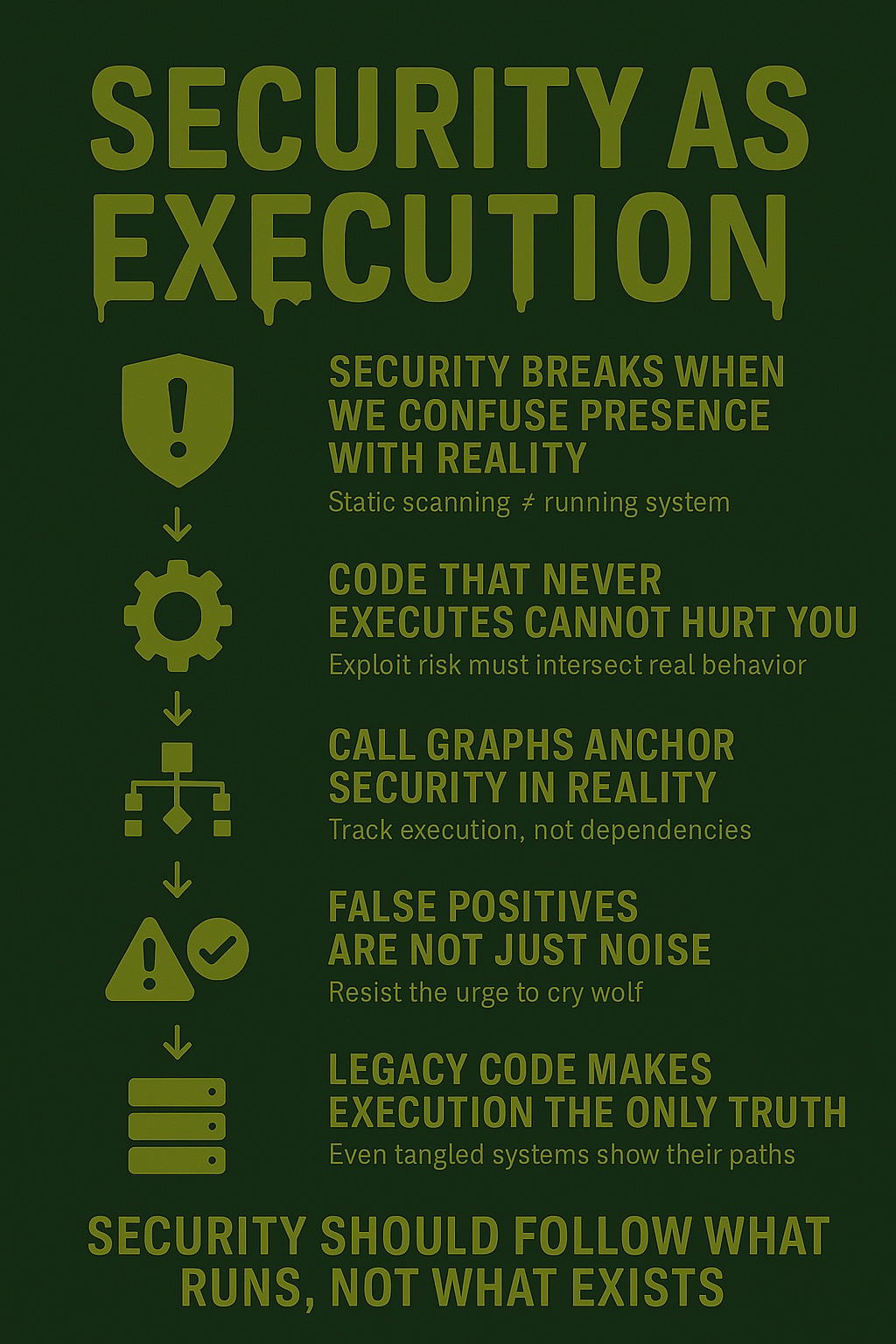
Security Breaks When We Confuse Presence With Reality
Most security conversations start from an assumption that quietly distorts everything that follows. If a dependency exists, it must matter. If a vulnerability is detected, it must be urgent. The result is a steady accumulation of alerts that feel important but remain oddly disconnected from how the system actually behaves. Engineers spend their time reacting to findings without ever being shown how those findings intersect with real execution. Security becomes something that happens to the codebase, not something derived from it.
This confusion comes from treating software as a static artifact rather than a running system. Files, packages, and versions are easy to scan. Execution paths are harder. But only one of those reflects reality.
Code That Never Executes Cannot Hurt You
A vulnerability sitting inside a dependency is only meaningful if the vulnerable code is reachable. If the function is never called, if the path is never exercised, if no input can ever reach it, then the risk is theoretical. It exists in documentation, not in production. Yet most tools never ask this question. They stop at presence, and presence alone is enough to trigger alarms.
This is how teams end up fixing things that would never have failed, never have been exploited, and never would have mattered. Security effort gets spent on hypothetical risk while real execution paths remain unexamined.
Call Graphs Anchor Security in Reality
Once you shift the frame from packages to call graphs, the entire conversation changes. Instead of asking whether a library is vulnerable, you ask whether a vulnerable function is ever reached. Instead of counting dependencies, you trace execution. Risk becomes something you can follow through the system rather than something you infer from metadata.
This isn’t a small improvement in accuracy. It’s a categorical shift. False positives fall away because the system is evaluated as it actually runs, not as it appears on disk. Security becomes evidence-based, not assumption-based.
False Positives Are Not Just Noise
False positives don’t merely slow teams down. They train teams to ignore security altogether. When engineers repeatedly see issues that have no execution relevance, they stop trusting the signal. Over time, everything starts to look the same, whether it matters or not.
This is not a human failure. It’s a tooling failure. When security systems refuse to distinguish between reachable and unreachable code, they force engineers to do that filtering mentally. Eventually, they stop trying.
Exploitability Is a Property of Execution
Exploitability is not a severity score. It is not a CVE description. It is a question of whether an attacker can actually traverse a path through the system to reach vulnerable logic. That question can only be answered by understanding execution, not by reading dependency manifests.
When security findings are tied to real call paths, exploitability becomes concrete. Teams can see why something matters, how it could be abused, and what would need to change to eliminate the risk. Security stops being abstract and starts behaving like engineering.
Upgrade Fear Comes From Lack of Simulation
One of the hidden costs of static security analysis is upgrade paralysis. Teams delay updates because they can’t predict impact. Every change feels dangerous because nothing models how changes propagate through real execution paths. The unknown becomes scarier than the known risk.
Execution-aware analysis allows upgrades to be simulated before they happen. Instead of guessing, teams can see what breaks, what remains unaffected, and what truly needs attention. Confidence replaces hesitation, not because risk disappears, but because it becomes visible.
Legacy Code Makes Execution the Only Truth
Legacy systems expose the limits of name-based security immediately. Versions are unclear. Dependencies are copied, forked, or embedded. Attribution becomes unreliable. Static identification breaks down under the weight of history.
But execution still tells the truth. If the code runs, it matters. If it doesn’t, it doesn’t. Even in the most tangled codebases, execution paths remain the only stable signal. Everything else is approximation.
Security Should Follow What Runs, Not What Exists
The core idea is not complicated, but it is deeply uncomfortable for traditional security tooling. Security should be grounded in actual execution paths, not static fear. Presence alone is not risk. Vulnerability alone is not danger.
When security aligns itself with how software actually behaves, it becomes precise, credible, and actionable. When it doesn’t, it becomes theater. And no amount of scanning can compensate for the wrong mental model.
In the end, this isn’t really a debate about tools or techniques. It’s a question of honesty. Are we securing the systems we actually run, or the systems we imagine we have? When security follows execution, it aligns naturally with how engineers already think — in flows, paths, and consequences. When it doesn’t, it drifts into abstraction and anxiety. The systems don’t get safer, just louder. Real security begins the moment we stop asking what might exist and start paying attention to what truly happens.
And that brings us to the end of today’s post, hope you enjoyed!